
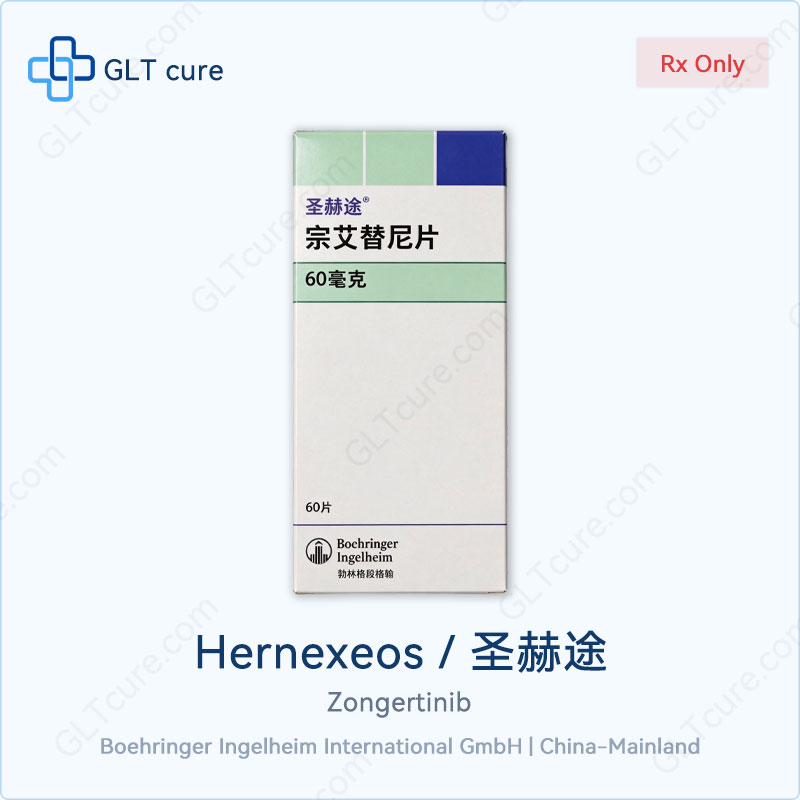
If you searched "hernexeos 60 mg tablet," you are looking for zongertinib — the first, and still the only, oral HER2 tyrosine kinase inhibitor approved for adults with HER2 (ERBB2) tyrosine kinase domain (TKD) mutation-positive, unresectable or metastatic non-small cell lung cancer (NSCLC). Each Hernexeos tablet contains 60 mg of zongertinib; the prescribed daily dose is a weight-based 120 mg or 180 mg, taken once daily. GLT supplies the zongertinib (Hernexeos, 圣赫途) 60 mg tablets, the NMPA-approved China originator presentation, on an inquiry basis.
What Is Zongertinib (Hernexeos)?
Zongertinib is an oral, once-daily, irreversible and highly selective HER2 (ERBB2) tyrosine kinase inhibitor (TKI). In NSCLC, about 2–4% of tumors carry a HER2 TKD activating mutation — an abnormality that drives constant growth signaling and is disproportionately common in women, never-smokers, lung adenocarcinoma, and younger patients. These HER2-mutant tumors are aggressive, carry a high risk of brain metastasis, and have historically had a poor prognosis because no oral targeted therapy existed for them.
Zongertinib was engineered to change that. Its key design feature is selectivity: it binds the HER2 kinase without meaningfully affecting wild-type EGFR, so it avoids the severe rash and diarrhea that classically limit pan-HER/EGFR inhibitors. The medicine was developed by Boehringer Ingelheim, the German research-driven pharmaceutical company, under the development code BI 1810631, and is commercialized worldwide under the brand Hernexeos (圣赫途, zōng'àitìní / 宗格替尼 in Chinese).
Zongertinib Brand: Hernexeos (圣赫途)
The zongertinib brand name is Hernexeos, known in China as 圣赫途. It is the originator brand developed by Boehringer Ingelheim under the code BI 1810631 — the same molecule worldwide, with only the regional label differing. In mainland China, Hernexeos is co-promoted by Boehringer Ingelheim together with Sino Biopharm (中国生物制药), and it is the NMPA-approved oral HER2 TKI for HER2-mutant NSCLC. GLT supplies the China-approved Hernexeos (圣赫途) 60 mg tablets as the primary presentation.
What Is Hernexeos Used For?
Zongertinib is approved for a single, precisely defined indication: unresectable or metastatic non-squamous NSCLC in adults whose tumor carries a HER2 (ERBB2) TKD activating mutation, as confirmed by an approved molecular test. The approval initially covered patients who had received at least one prior systemic therapy, and was later expanded to the first-line setting:
- August 2025 — China NMPA and US FDA granted conditional/accelerated approval for previously treated patients.
- February 2026 — US FDA extended accelerated approval to first-line treatment.
- May 2026 — China NMPA approved the first-line indication.
This makes zongertinib both the first oral HER2 TKI ever approved and the only one covering HER2-mutant NSCLC from front-line through later lines. Because the drug depends on a specific biomarker, treatment is selected only after HER2 mutation testing — a detail any buyer should confirm with their oncologist before sourcing.
Zongertinib Dosage: 60 mg Tablets, Weight-Based Dosing
This is the point where the zongertinib dosage is easiest to misread, so read carefully. Hernexeos comes as 60 mg film-coated tablets, 60 tablets per bottle. But the daily dose is not one 60 mg tablet — it is weight-based and taken as multiple tablets once daily:
- Body weight under 90 kg: 120 mg once daily (2 × 60 mg tablets).
- Body weight 90 kg or above: 180 mg once daily (3 × 60 mg tablets).
The tablets are swallowed whole with water, with or without food, at about the same time each day. If a dose is missed and the next dose is more than 12 hours away, take it as soon as remembered; if less than 12 hours, skip the missed dose and resume the normal schedule — never double up. If vomiting occurs after a dose, do not take a replacement; continue on schedule the next day. Treatment continues until disease progression or unacceptable toxicity, with dose adjustments made by the treating physician.
How Well Does It Work? The Beamion LUNG-1 Data
The approval rests on the international Beamion LUNG-1 trial, and the numbers explain why this medicine has changed practice for a historically hard-to-treat subgroup:
- Previously treated patients: a confirmed objective response rate (ORR) of 71%, with a disease control rate of 96% and a median progression-free survival (mPFS) of 12.4 months.
- First-line (treatment-naive) patients: a confirmed ORR of 76%, with a median duration of response of 15.2 months and an mPFS of 14.4 months.
- Active brain metastases: in a subgroup of 30 patients, 47% achieved a confirmed intracranial response (iORR) by RANO-BM — relevant given how often HER2-mutant NSCLC spreads to the brain.
These results were published in the New England Journal of Medicine and reported at major oncology meetings (AACR and ELCC). They are the clinical foundation for zongertinib's first-line and later-line positioning, and for its inclusion in NCCN guidance for HER2-mutant advanced NSCLC.
Safety: Mostly Low-Grade, With a Few Important Warnings
Zongertinib's tolerability profile is a key part of its value — most adverse events are low-grade and treatment discontinuation is uncommon (about 2.9% in the pivotal cohort). The most common reactions (each roughly 20% or more) are:
- Diarrhea (~53%)
- Hepatotoxicity / elevated liver enzymes (~27%)
- Rash (~27%)
- Fatigue (~22%)
- Nausea (~21%)
The prescribing information carries warnings and precautions for hepatotoxicity, left ventricular dysfunction (evaluate ejection fraction before treatment and monitor), interstitial lung disease / pneumonitis (watch for new cough, breathlessness or fever), and embryo-fetal toxicity (contraceptive use is required during and briefly after treatment). Liver function is checked every two weeks for the first 12 weeks, then monthly. Because of these monitoring requirements, zongertinib should always be used under the supervision of an oncologist experienced with targeted cancer therapy.
Zongertinib Cost and Where to Buy
For an oral cancer therapy taken continuously, zongertinib cost is a real consideration. GLT supplies the China-approved originator presentation at an indicative around $1,000 per 60 mg × 60-tablet bottle — a genuine, properly stored, NMPA-approved product. Because zongertinib is a prescription oncology medicine, GLT follows an inquiry process rather than a self-service cart:
- Confirm the HER2 (ERBB2) TKD mutation status and the 120 mg / 180 mg dosing with your oncologist.
- Send your inquiry via WhatsApp or email with the strength and quantity you need.
- Our team verifies availability and batch details, then arranges dispatch with appropriate storage.
Questions or ready to order? Contact us on WhatsApp +86 15234153837 or email [email protected].
Frequently Asked Questions
What is Hernexeos 60 mg used for?
Hernexeos (zongertinib) is used to treat adults with unresectable or metastatic non-squamous non-small cell lung cancer (NSCLC) whose tumor carries a HER2 (ERBB2) tyrosine kinase domain activating mutation. It is approved for both previously treated and first-line patients.
What is the dose of zongertinib?
Zongertinib is taken once daily by weight: 120 mg (2 × 60 mg tablets) for patients under 90 kg, and 180 mg (3 × 60 mg tablets) for patients 90 kg or above. Each tablet contains 60 mg.
What is the brand name of zongertinib?
The brand name is Hernexeos (圣赫途 in China), developed by Boehringer Ingelheim. In China it is co-promoted with Sino Biopharm (中国生物制药) as the NMPA-approved oral HER2 TKI for HER2-mutant NSCLC.
How much does zongertinib cost?
GLT's indicative price is around $1,000 per 60 mg × 60-tablet bottle for the China-approved originator (Hernexeos / 圣赫途). Contact GLT for a current quote.
Who makes zongertinib?
Zongertinib was developed by Boehringer Ingelheim, the German pharmaceutical company, under code BI 1810631. In China it is co-promoted with Sino Biopharm (中国生物制药).
Does zongertinib work for brain metastases?
Yes. In the Beamion LUNG-1 trial, a subgroup of 30 patients with active brain metastases showed a 47% confirmed intracranial objective response rate (iORR), indicating meaningful activity in the brain.
Medical disclaimer: This article is for informational purposes only and does not constitute medical advice. Zongertinib (Hernexeos / 圣赫途) is a prescription oncology medicine; always consult a qualified oncologist about diagnosis, HER2 mutation testing, dosing, and treatment. Prices are indicative and subject to confirmation at inquiry.