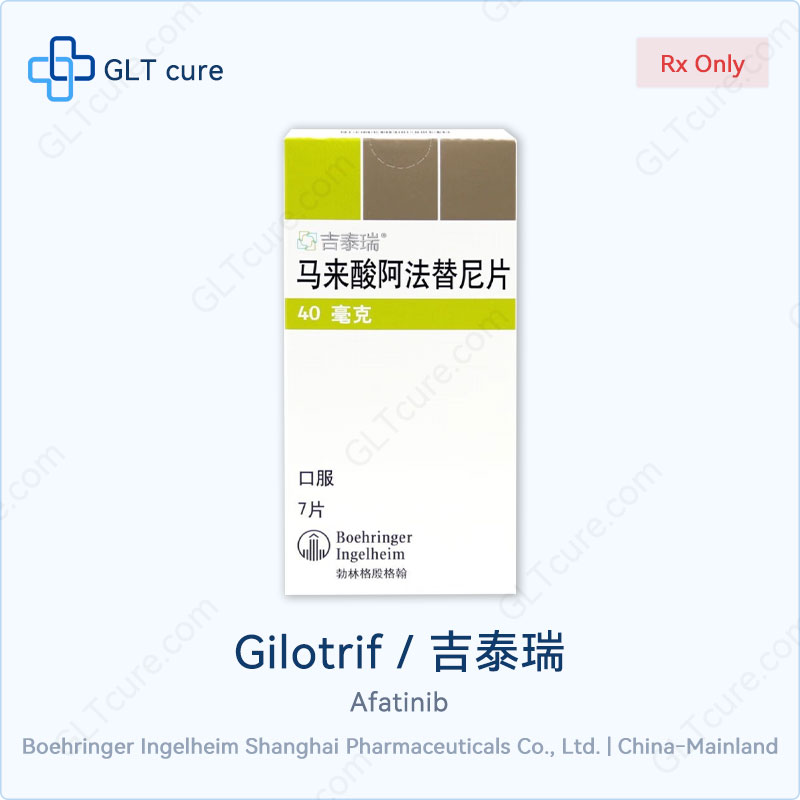
If you are searching for the afatinib price, you are looking at the cost of Gilotrif (吉泰瑞 in Chinese), Boehringer Ingelheim's second-generation oral EGFR inhibitor for EGFR-mutant non-small cell lung cancer (NSCLC). GLT supplies the China-sourced Gilotrif (Afatinib) 30mg/40mg tablets at an indicative price of around $130 for a 40 mg × 7-tablet strip, with the 30 mg strip around $110.
What Is Afatinib (Gilotrif)?
Afatinib is a second-generation, irreversible EGFR tyrosine kinase inhibitor (TKI) developed by Boehringer Ingelheim. Unlike first-generation EGFR inhibitors that bind reversibly, afatinib covalently binds to the kinase domains of EGFR (ErbB1), HER2 (ErbB2) and HER4 (ErbB4) and irreversibly blocks their signaling. This broader, permanent blockade is why afatinib remains a useful option in EGFR-mutant lung cancer and in squamous NSCLC that has progressed after chemotherapy.
The medicine is sold under three related brand names: Gilotrif in the United States, Giotrif in Europe, and 吉泰瑞 (Giotrif) in China. All three contain the same active ingredient, afatinib dimaleate. The product GLT supplies is the China-market presentation from Boehringer Ingelheim, supplied in compact 7-tablet strips in 30 mg and 40 mg strengths. You can review the full official prescribing information on the DailyMed entry for Gilotrif.
How Does Afatinib Work?
Afatinib is a second-generation EGFR-TKI, which means it works differently from the first-generation drugs (gefitinib and erlotinib) in an important way. The first-generation TKIs bind to EGFR reversibly, so the drug can detach and the receptor can reactivate. Afatinib instead forms a covalent, irreversible bond with the kinase domains of EGFR, HER2 and HER4, permanently shutting those receptors down until the cell replaces them. This broader ErbB-family blockade and irreversible binding are the defining features of the second generation, and they are the reason afatinib retains activity against certain uncommon EGFR mutations and remains a useful option in squamous disease.
What Is Afatinib Used For?
Afatinib is approved for two settings in non-small cell lung cancer:
- EGFR mutation-positive metastatic NSCLC — as first-line treatment for patients whose tumors carry non-resistant EGFR mutations (such as exon 19 deletions or the L858R point mutation), confirmed by a validated test.
- Squamous NSCLC progressing after platinum-based chemotherapy — for patients with metastatic squamous histology whose disease has advanced despite platinum-based doublet chemotherapy.
In China, afatinib is on the national medical insurance list as a Category B drug, with reimbursement limited to these two indications. The key practical point is that afatinib is not for everyone with lung cancer — it is selected based on EGFR mutation testing and prior treatment history, so the decision always sits with an oncologist.
Afatinib Dosage and Strengths
Afatinib is taken as an oral tablet once daily. The standard dose is 40 mg once daily, and it must be taken on an empty stomach — at least one hour before or two hours after a meal — because food significantly affects absorption. The tablets come in 20 mg, 30 mg and 40 mg strengths (the China label also lists 50 mg), with the 40 mg tablet being the usual starting dose.
The dose can be reduced in 10 mg steps depending on tolerability, and patients with severe kidney impairment start on 30 mg. The China presentation is supplied in 7-tablet strips (one week's supply per strip), whereas the US presentation comes in 30-tablet bottles. This is why price comparisons should always be made on a per-tablet or per-month basis rather than per pack.
Side Effects and Safety Monitoring
Like all EGFR inhibitors, afatinib has a well-known side-effect profile that patients should expect and manage rather than be surprised by. The most common adverse reactions (occurring in at least 20% of patients) are diarrhea, rash or acneiform dermatitis, stomatitis, paronychia (nail-bed inflammation), dry skin, decreased appetite, nausea, vomiting and itching. Diarrhea is the one to take most seriously — it occurs in nearly all patients and, if untreated, can lead to dehydration and kidney problems, so it should be reported to the treating doctor early and managed with hydration and anti-diarrheal medication.
Several less common but serious events also require awareness. Interstitial lung disease (ILD) occurs in about 1.6% of patients, so any new or worsening cough, breathlessness or fever should prompt immediate medical review. Other warnings include bullous and exfoliative skin disorders, hepatic toxicity (monitored with periodic liver tests), gastrointestinal perforation and keratitis (eye inflammation). Because afatinib can harm a developing fetus, effective contraception is advised during treatment. Regular follow-up and prompt reporting of new symptoms are the cornerstones of staying on therapy safely.
Afatinib Price and Cost
When people search "afatinib price" or "afatinib cost," they are usually asking two different questions: what a single strip or bottle costs up front, and what a full month of treatment costs. Here is how the China-sourced originator breaks down through GLT:
- 40 mg × 7-tablet strip: around $130.
- 30 mg × 7-tablet strip: around $110.
- At the standard 40 mg once-daily dose, a month of treatment is roughly four strips, putting the monthly cost in the region of $500–$550.
For reference, the originator afatinib in mainland China is reimbursed at roughly 140 RMB per 40 mg tablet, or about 4,200 RMB per month at the standard dose, and China's generic afatinib versions are priced lower still. GLT's indicative pricing reflects the China-market level rather than Western list prices, and the exact figure is confirmed at inquiry with batch and expiry details. The Boehringer Ingelheim Germany-origin Gilotrif 40mg is also available on a quote basis.
For cost-sensitive patients, China's approved generic afatinib versions are priced below the originator and can be a practical alternative when the treating doctor agrees. One comparison tip worth remembering: because the China originator is supplied in 7-tablet strips while the US version comes in 30-tablet bottles, always compare on a per-tablet or per-month basis rather than per pack — an apparent difference in pack price is usually just a difference in pack size, not a real difference in unit cost.
Where to Buy Afatinib
If your search is "buy afatinib," the practical route is an inquiry-based sourcing process, because afatinib is a prescription oncology medicine:
- Confirm the EGFR mutation status and that afatinib is the right option with your oncologist.
- Send your inquiry via WhatsApp or email with the strength (30 mg or 40 mg), pack size (7-tablet strip) and the quantity you need.
- Our team verifies availability, batch and expiry, then arranges dispatch with appropriate handling.
For broader guidance on sourcing oncology medicines from China, see our China-sourced oncology medicines guide, and browse our other buying guides for related treatments.
What to Check Before You Buy Afatinib
Because afatinib is a prescription cancer medicine, a few checks help ensure you receive a genuine, correctly handled product:
- Confirm the EGFR mutation status and that afatinib matches the indication with your oncologist before ordering.
- Verify the pack details: strength (30 mg or 40 mg), pack size (7-tablet strip) and the batch number and expiry date.
- Check storage — afatinib should be kept in its original container, protected from high humidity and light, at room temperature.
- Buy through a traceable channel that can provide batch documentation rather than an unverified reseller.
GLT's inquiry process covers these points before dispatch, so you receive a product with confirmed origin, batch and expiry.
Questions or ready to order? Contact us on WhatsApp +86 15234153837 or email [email protected].
Frequently Asked Questions
What is afatinib used for?
Afatinib is used to treat EGFR mutation-positive metastatic non-small cell lung cancer as first-line therapy, and squamous NSCLC that has progressed after platinum-based chemotherapy. It is selected based on EGFR mutation testing.
Is Gilotrif the same as Giotrif and 吉泰瑞?
Yes. Gilotrif is the US brand, Giotrif is the European brand, and 吉泰瑞 (Giotrif) is the China brand — all contain the same active ingredient, afatinib dimaleate, from Boehringer Ingelheim.
How is afatinib dosed?
The standard dose is 40 mg once daily on an empty stomach, at least one hour before or two hours after a meal. The dose can be reduced in 10 mg steps based on tolerability.
How much does afatinib cost?
GLT's indicative price for China-sourced Gilotrif is around $130 for a 40 mg × 7-tablet strip, or around $110 for the 30 mg strip. The Germany-origin version is available on a quote basis.
Who makes afatinib?
Afatinib was developed by Boehringer Ingelheim and was first approved by the US FDA in 2013. It is sold as Gilotrif (US), Giotrif (Europe) and 吉泰瑞 (China).
Do I need a prescription to buy afatinib?
Yes. Afatinib is a prescription oncology medicine. GLT's inquiry process includes verification before dispatch — contact us via WhatsApp or email, and our team will guide you through what is required.
Medical disclaimer: This article is for informational purposes only and does not constitute medical advice. Afatinib (Gilotrif/Giotrif) is a prescription cancer medicine; always consult a qualified oncologist or healthcare professional about diagnosis, dosage and treatment. Prices are indicative and subject to confirmation at inquiry.