
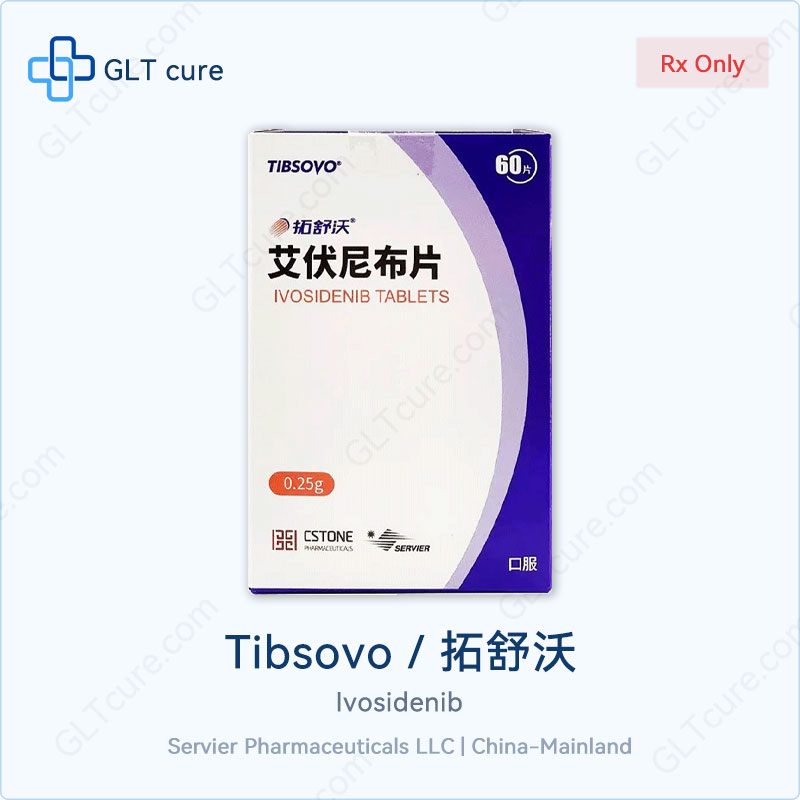
If you searched "tibsovo ivosidenib china license," you are asking two things: whether the originator IDH1 inhibitor ivosidenib — sold as Tibsovo in the United States and as 拓舒沃 in China — has Chinese marketing approval, and where a China-sourced supply can be obtained. The short answer: yes, ivosidenib received its China license in January 2022 as the country's first approved IDH1 inhibitor, and GLT supplies the Tibsovo (Ivosidenib) 250mg tablets, the Servier China presentation, at an indicative price of around $4,500 for a 250mg × 60-tablet box.
What Is Tibsovo (Ivosidenib)?
Tibsovo (ivosidenib) is a first-in-class, small-molecule isocitrate dehydrogenase-1 (IDH1) inhibitor — an oral targeted cancer therapy rather than a conventional chemotherapy. The molecule was discovered by Agios Pharmaceuticals; today the product is owned and commercialized worldwide by Servier (施维雅), which acquired Agios's oncology business. In the United States the brand is Tibsovo, and the China-registered Chinese brand name is 拓舒沃 (Tuòshūwò), with the generic name 艾伏尼布 (ivosidenib).
In patients with acute myeloid leukemia (AML), an IDH1 mutation (most commonly R132H or R132C) drives the mutant enzyme to produce high levels of 2-hydroxyglutarate (2-HG), an oncometabolite that blocks normal myeloid differentiation and keeps leukemia cells immature and proliferating. By inhibiting the mutant IDH1 enzyme, ivosidenib lowers 2-HG levels and pushes the malignant cells to differentiate into more normal, mature blood cells — a fundamentally different mechanism from killing cells with chemotherapy. This is why the treatment works on the underlying mutation rather than simply attacking fast-dividing cells.
Tibsovo China License: Approval History
The Tibsovo ivosidenib China license story runs through three milestones. In August 2021, CStone Pharmaceuticals (基石药业), Servier's China commercialization partner, announced that the new drug application (NDA) had been accepted by the NMPA and granted priority review. In January 2022, the NMPA granted conditional approval for ivosidenib tablets, making it the first IDH1 inhibitor approved in Mainland China. The registered product is the 250mg tablet under marketing authorization number 国药准字HJ20220002, with Servier Pharmaceuticals LLC as the marketing authorization holder.
Two important caveats shape how the China license is used in practice. First, the Chinese approval is a conditional approval covering adults with relapsed or refractory AML carrying a susceptible IDH1 mutation — narrower than the US label, which also includes newly diagnosed AML, relapsed/refractory MDS, and cholangiocarcinoma. Second, ivosidenib has been added to China's national reimbursement drug list (NRDL) as a category-B negotiated medicine; the current reimbursement scope is limited to IDH1-mutant relapsed/refractory AML, with the agreement period running to the end of 2027. Cholangiocarcinoma patients cannot claim the AML reimbursement indication.
Approved Indications: China vs the United States
The indication difference matters because the same box of medicine carries different labels on each side of the Pacific. In China, the approved indication is a single one: relapsed or refractory AML in adults with a susceptible IDH1 mutation. In the United States, the FDA label (first approved 2018) covers four indications:
- Newly diagnosed AML — in combination with azacitidine or as monotherapy, for adults aged 75 or older, or with comorbidities precluding intensive induction chemotherapy.
- Relapsed or refractory AML — the same indication approved in China.
- Relapsed or refractory myelodysplastic syndromes (MDS) — added in October 2023.
- Locally advanced or metastatic cholangiocarcinoma (bile-duct cancer) — for previously treated patients.
Whenever a patient or caregiver compares labels, the key point is that the active medicine is identical; only the registered indications differ by region. Treatment selection always rests on a confirmed IDH1 mutation test and a hematologist's or oncologist's assessment.
Dosing and the 250mg Tablet Strength
Ivosidenib comes as a 250mg blue, oval, film-coated tablet, debossed "IVO" on one side and "250" on the other, supplied in 60-tablet bottles. The recommended dose is 500mg once daily — that is, two 250mg tablets taken at the same time each day — with or without food, until disease progression or unacceptable toxicity. Because a high-fat meal raises drug exposure, patients should avoid taking the tablets with a high-fat meal. The tablets must be swallowed whole and not split, crushed, or chewed.
Treatment is continued for at least six months in patients who do not progress, to give the differentiation response time to emerge. Patients who vomit after a dose should not take a replacement dose, and a missed dose should be taken as soon as remembered provided there are at least 12 hours before the next scheduled dose — never two doses within 12 hours. Regular blood counts, chemistry panels, and electrocardiograms are required throughout therapy.
Before starting treatment, a confirmed IDH1 mutation is mandatory. Patients are selected based on the presence of a susceptible IDH1 mutation detected by a validated test on bone marrow or peripheral blood. Treatment should never begin without this molecular confirmation, because ivosidenib has no meaningful activity against IDH1 wild-type disease — the mutation, not the diagnosis alone, is what makes the therapy appropriate.
Safety: Differentiation Syndrome and Other Key Warnings
Tibsovo carries a boxed warning for differentiation syndrome in AML and MDS — the most important safety issue to understand before treatment. Differentiation syndrome occurs when the drug's mechanism works too quickly: myeloid cells differentiate and proliferate rapidly, producing fever, dyspnea, hypoxia, pulmonary infiltrates, pleural or pericardial effusions, rapid weight gain, hypotension, and potential multi-organ dysfunction. It can appear as early as one day and up to three months after starting treatment and can be fatal if untreated. Management is immediate corticosteroid therapy plus hemodynamic monitoring until symptoms resolve.
Two further warnings round out the safety profile. QTc interval prolongation can cause life-threatening irregular heartbeats, so electrocardiograms and electrolytes are monitored before and during treatment; strong or moderate CYP3A4 inhibitors require a dose reduction. Guillain-Barré syndrome has been reported, and treatment is permanently discontinued if it is diagnosed. Common adverse reactions in AML include decreased blood cell counts, diarrhea, fatigue, edema, nausea, vomiting, decreased appetite, joint pain, rash, and elevated liver or kidney function tests.
Tibsovo Price and China Supply
Price is where the China supply question usually lands. In Mainland China, the originator ivosidenib (250mg × 60 tablets) has a public list price of roughly RMB 35,888 per box (about $5,000) before reimbursement, with the actual out-of-pocket amount depending on NRDL coverage, hospital or pharmacy channel, and the patient's insurance status. For international buyers sourcing a genuine China-market presentation, GLT lists the Tibsovo (Ivosidenib) 250mg tablets at an indicative around $4,500 for the 250mg × 60-tablet box.
For patients who specifically want the US-labeled version, GLT also lists the Tibsovo (Ivosidenib) 250mg tablets — USA version on a quote basis. Generic ivosidenib presentations from Laos-based manufacturers also exist on the market, but originator sourcing through a verifiable channel is the safer default for a boxed-warning oncology medicine.
Where to Buy Tibsovo (Ivosidenib) Online
Because ivosidenib is a prescription oncology medicine with a boxed warning, GLT follows an inquiry process rather than a self-service cart. The path is straightforward:
- Confirm the IDH1 mutation and the indication with your hematologist or oncologist.
- Send your inquiry via WhatsApp or email with the strength, quantity, and preferred source (China or US presentation).
- Our team verifies availability and batch details, then arranges dispatch with appropriate storage.
For a broader look at sourcing China-approved oncology medicines, see our guide to sourcing China-sourced oncology medicines, and browse our other buying guides for related targeted therapies.
Questions or ready to order? Contact us on WhatsApp +86 15234153837 or email [email protected].
Frequently Asked Questions
Is Tibsovo approved in China?
Yes. Ivosidenib (Tibsovo / 拓舒沃) received conditional NMPA approval in January 2022 as China's first IDH1 inhibitor, under marketing authorization number 国药准字HJ20220002, for relapsed or refractory IDH1-mutant AML in adults.
What is the Chinese name for Tibsovo?
The Chinese brand name is 拓舒沃 (Tuòshūwò), and the generic name is 艾伏尼布 (ivosidenib). The marketing authorization holder is Servier, with CStone Pharmaceuticals as the China commercialization partner.
What is ivosidenib used for?
Ivosidenib treats cancers driven by an IDH1 mutation. In China it is approved for relapsed or refractory AML; in the US it additionally covers newly diagnosed AML, relapsed/refractory MDS, and previously treated cholangiocarcinoma.
What is the dose of Tibsovo?
The recommended dose is 500mg once daily — two 250mg tablets — taken at the same time each day with or without food, while avoiding high-fat meals. Treatment continues until progression or unacceptable toxicity.
How much does Tibsovo cost in China?
The China list price is roughly RMB 35,888 per 250mg × 60-tablet box before NRDL reimbursement. GLT's indicative price for the China-sourced originator presentation is around $4,500 per box.
Does Tibsovo have a boxed warning?
Yes. Tibsovo carries a boxed warning for differentiation syndrome in AML and MDS, which can be life-threatening or fatal. It requires immediate corticosteroid therapy and hemodynamic monitoring if suspected.
Medical disclaimer: This article is for informational purposes only and does not constitute medical advice. Ivosidenib (Tibsovo / 拓舒沃) is a prescription oncology medicine with a boxed warning; always consult a qualified hematologist or oncologist about diagnosis, dosing, and treatment. Prices are indicative and subject to confirmation at inquiry.